Join us this Thursday July 25th at the Arundel Farm Gallery for a FREE lecture on creating Japanese-Inspired Gardens here in Maine!
To reserve a spot, please see our Facebook Event Page, or contact the Gallery here
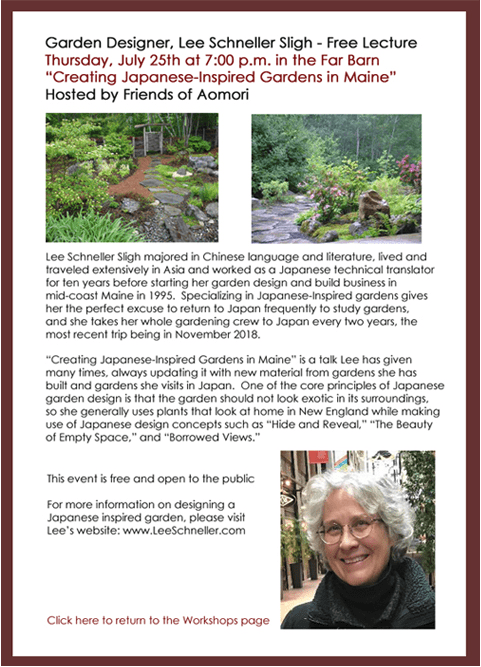
Join us this Thursday July 25th at the Arundel Farm Gallery for a FREE lecture on creating Japanese-Inspired Gardens here in Maine!
To reserve a spot, please see our Facebook Event Page, or contact the Gallery here
Berwick Academy, partnering with Friends of Aomori, is pleased to host Hashi / 橋, the second annual Maine-Aomori student print exchange exhibit at Berwick Academy’s Jackson Library Gallery in South Berwick, Maine from March 27-April 12, 2019. Hashi means “bridge” in Japanese.
This exhibit will feature over 70 prints made by students in Aomori, Japan. Raegan Russell, Visual Art Chair and art teacher at Berwick traveled to Aomori as a teacher delegate in November, 2018 and that trip sparked this exhibition.
We hope to see you there!

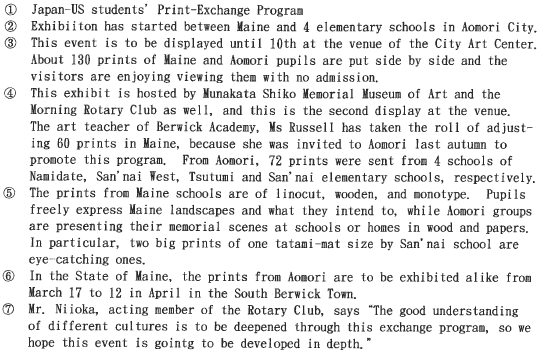
The second annual Children’s Print Exchange between the students of Maine and Aomori had its official opening at the Munakata Shiko Memorial Museum in Aomori this past weekend! Shared below are the newspaper feature and it’s annotated translation.
We hope to see you at the upcoming reception here in Maine at Berwick Academy (see this post for the show details)!
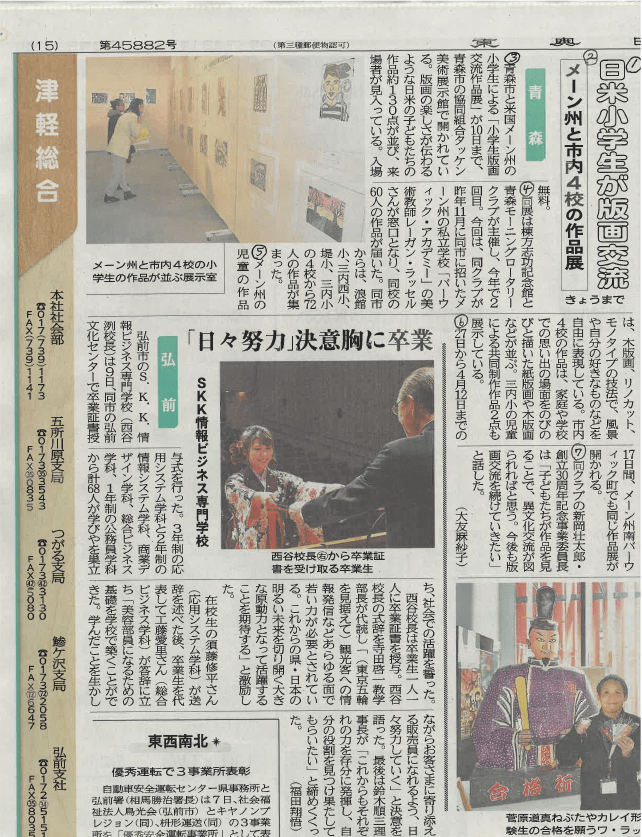
Thank you to our partner Ono-san at the Munakata Museum for this annotated translation of the Newspaper Article shown above:
This past September, Raegan Russell was chosen after an open call for applications from art teachers in Maine who would be interested in both representing Friends of Aomori on a Delegation visit to Aomori, Japan, and leading the creation of the next installment of our Children’s Print Exchange. Raegan’s visit to Aomori was completed this past Sunday (November 18th, 2018) and now her and her Berwick Academy students will soon begin working on their woodblock prints! These prints will be sent to Aomori in February, the same time that we here in Maine will receive the prints from the Japanese students (exhibition location TBA).
Attached below are some pictures Raegan shared from her visit; it certainly seems that a wonderful time was had by all!
You can also read a brief Japanese statement about the Delegation visit on this website: https://www.toonippo.co.jp/articles/-/114623
Stay tuned to this website as well as our Facebook Page for more updates on the 2019 Children’s Print Exchange!


The Fourth Annual MAPS Exhibit has received a wonderful reception at the Munakata Shiko Memorial Museum of Art in Aomori, Japan! We will be posting updates on the Fourth annual MAPS Exchange as they come, so stay tuned. There are many exciting things happening here at Friends and we can not wait to share them with you!
While Maine is in its peak season of fall foliage, and encountering the subsequent stream of leaf-peeping tourists, Hirosaki Castle Botanical Garden in Aomori, Japan is gearing up for its annual Chrysanthemum and Autumn Foliage Festival which runs from October 20th through November 12th. During this event, the Garden is filled with different events for visitors, including craft-making, boat rides, petting zoo, apple pie tasting, and many other Autumn related activities. There is also an ‘Autumn Foliage Light Up’ where the garden is open late (until 9pm) and the trees are lit-up in the night by outdoor lights in order to accentuate the bright colors.
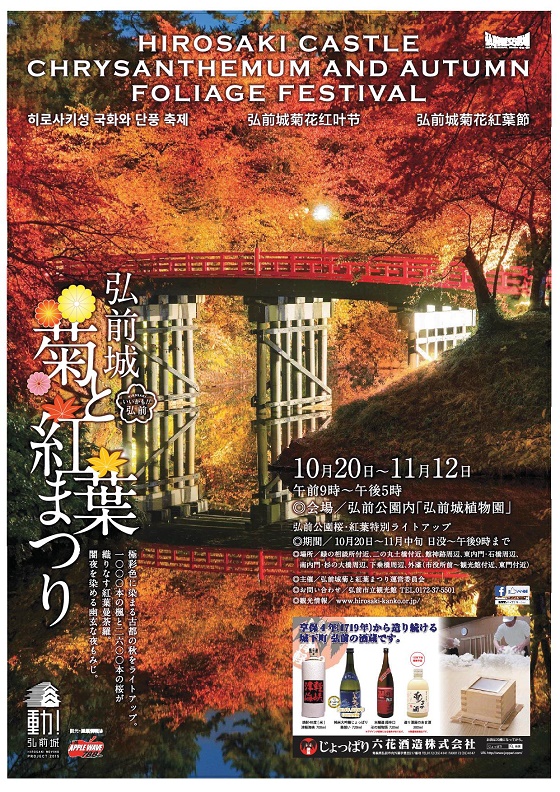
Of course, the Hirosaki Castle Botanical Garden is not the only place to see the fall foliage of Aomori; in fact, there are many viewing locations scattered throughout the region! Perhaps the most well-known viewing location is the Oirase Gorge, a National Natural Monument and National Scenic Place of Beauty located in Towada-Hachimantai National Park . With the thick forest and roaring waterfalls of the Oirase Gorge, hikers can experience fall foliage in an untouched, wild environment far away from the hustle and bustle of Hirosaki City.
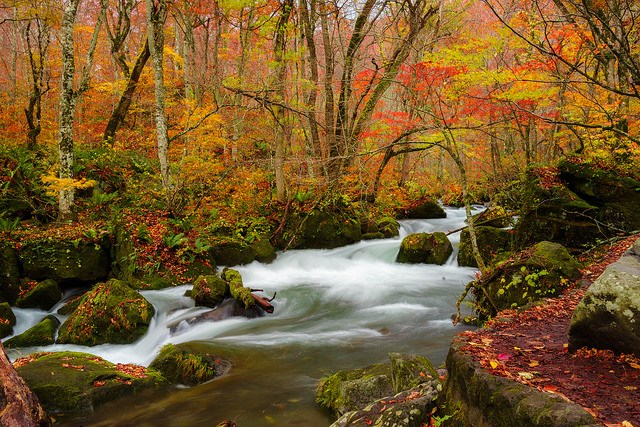
For information on more areas to view the Fall Foliage in Aomori Prefecture, or to learn more about the two highlighted here, please click on the links below!
Hirosaki Castle Botanical Garden:
http://www.hirosaki-kanko.or.jp/en/edit.html?id=autumn-foliage
https://www.en-aomori.com/culture-044.html
Oirase Gorge:
https://www.en-aomori.com/scenery-002.html
Other Places:
https://www.en-aomori.com/tag/autumn
https://www.kyuhoshi.com/2017/07/18/best-places-to-see-autumn-leaves-in-aomori/
If you will be in the Gonohe area, or are planning to make a trip to Aomori this coming Fall, you may want to think about planning your trip around the one-of-a-kind event known as: The Gonohe International Music Festival!
Beginning in 2013, the Gonohe International Music Festival is a free event that takes place annually at Kowataritai Park in the town of Gonohe, which is located within the Aomori prefecture. Started by Dave Herlich and Michael Warren – two friends who were English teachers in the town of Gonohe for several years – as a means of intercultural outreach and community, the Gonohe Music Festival has expanded over the years to include a wide variety of musicians, cultural performances, and seasonal/specialty foods from around the world as well as Japan/Aomori. While the festival features many cultural aspects unique to the Aomori prefecture, the Gonohe Music Festival also includes musical acts from a variety of foreign cultures and countries – such as a West African Drum Line (2013), a Reggae group (2015), and Beatles covers (2016) – while additionally showcasing Japanese indie, rock, jazz, fusion, and traditional music groups/bands.
The Fifth annual Gonohe International Music Festival will be held Sunday, October 8th of this year (2017) and is an all day affair – running from Sunrise to Sunset. While the music lineup has not yet been released, looking at the lists from previous years, it is safe to say that 2017 is sure to be a blast!


To hear samples of the music played at the 2013 Gonohe International Music Festival, click on the link here: https://gonohemusicfest.bandcamp.com/
A commentary by the founders of the Gonohe International Music Festival on the back story, goals, and future of the festival is available for listening here: http://www.pechakucha.org/presentations/harmony-in-aomori-the-gonohe-music-festival/play
For more information and to keep up to date on the 2017 line-up, please visit the festival’s main page at: http://www.gonohemusicfestival.com/2017
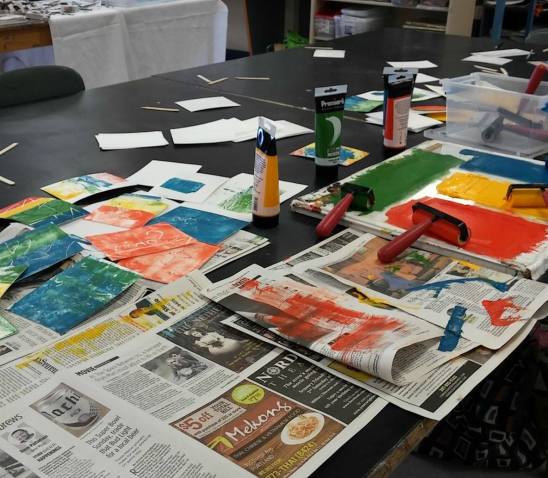
In line with the opening of the 2017 MAPS exhibition, this weekend’s written feature will be focusing on the process of making traditional Japanese woodblock prints. While not all of the prints in the MAPS exhibit are made in this manner, the process and its cultural resonance in Japan are certainly an integral part of and influence on printmaking worldwide.
(To see more details about MAPS 2017 see our home page)
Before delving into the process, first a brief introduction into the history of woodblock printing in Japan:
“Woodblock printing came to Japan during the eighth century and became the primary method of printing from the eleventh to the nineteenth centuries. As in China, the technology was first used to duplicate Buddhist texts and then later, books of Chinese origin. It was not until the 1500s that books originally in Japanese began to be printed. Black and white illustrations were a part of these early texts, to which color was sometimes added by hand, but eventually colored prints developed around 1765 as printing techniques improved. The first colored prints in Japan were original works of art, which soon led to the publishing of the popular, single-sheet ukiyo-e” (Khan Academy).
The woodblock printing process and the artistry of it that developed in Japan led the country to develop it’s own unique style, perspective, and craftsmanship in woodblock printing – a style which became known as ukiyo-e, or “images of the floating world”. While artists now are based less around the traditional ukiyo-e style, the technical process developed in Japan is still in use today.


The technical process of making a traditional woodblock print is intricate and requires an intense amount of concentration, accuracy, and skill. Listed below is the step by step methods of making such a print:
To see the process described above with more intricate detail, watch a video here!
For more information on the history, techniques, processes, as well as more examples of Japanese woodblock printing, please see the following references:
http://woodblock.com/encyclopedia/entries/011_07/011_07.html
http://www.druckstelle.info/en/holzschnitt_japan.aspx
http://viewingjapaneseprints.net/texts/topictexts/faq/faq_making_a_print.html
http://mercury.lcs.mit.edu/~jnc/prints/process.html
The First Showing of MAPS 2017 is Coming Right Up! the Yarmouth Historical Society, which is hosting the exhibit from May 1 to June 1, wrote a little introductory piece about the exhibit on their page to shed some light on what MAPS is all about. Check out their press release by clicking here!
Hope to see you on Thursday, May 11th!

 Friends of Aomori
You must be logged in to post a comment.